As summer approaches, the warmth is a welcome change, but rising temperatures often bring the unwelcome burden of soaring electricity bills. Finding an effective way to stay cool without breaking the bank is a common challenge for many households. This is where energy-efficient tower fans step in as a game-changer, offering a sleek, economical, and powerful solution to beat the heat. This guide will delve into what makes a tower fan energy-efficient, explore the top models available for Summer 2026, and provide essential tips to help you choose, use, and maintain the perfect fan for your needs, ensuring a comfortable and cost-effective season.
What is a Tower Fan and Why Are They Popular?
A tower fan is a distinctive type of electric fan characterized by its tall, slender, and vertical design. Unlike traditional box or pedestal fans that often feature visible rotating blades, tower fans typically house internal impellers or blowers, drawing air in through a rear intake and expelling it forward through a vertical grille. This design allows for a broad, oscillating airflow that can cool a wider area than many conventional fans.
Compared to other fan types, tower fans offer several unique advantages. Their compact footprint means they occupy minimal floor space, making them ideal for smaller rooms, apartments, or crowded office environments where larger fans might be cumbersome. Aesthetically, their modern and minimalist profiles allow them to blend seamlessly into contemporary home decor, often adding a touch of sophistication rather than being a conspicuous appliance. Many tower fans are also engineered for quieter operation, a crucial feature for bedrooms or workspaces where noise can be a significant disturbance. While some larger box or pedestal fans might move a greater volume of air directly, tower fans excel at widespread, consistent air circulation thanks to their oscillating motion. The combination of space-saving design, quiet functionality, and appealing aesthetics makes them increasingly popular for anyone seeking an efficient and stylish cooling solution.
Understanding Energy Efficiency in Tower Fans
The term “energy-efficient” is crucial when discussing tower fans, especially in contrast to power-hungry air conditioning units. A typical tower fan consumes between 30 to 100 watts of electricity, which is a mere fraction of what an air conditioner demands—ranging from 500 to 5000 watts for window or central AC units. This significant difference means that even running a tower fan all day costs just pennies, making them a remarkably economical choice for personal and room cooling.
A key factor distinguishing truly energy-efficient tower fans is the type of motor they employ. Fans equipped with DC (Direct Current) motors are notably more efficient, utilizing 30-50% less energy than traditional AC (Alternating Current) motors. These motors also tend to operate more quietly and allow for smoother, more precise speed adjustments, optimizing both comfort and power consumption. Beyond the motor, several features contribute to a tower fan’s energy-saving capabilities. Multiple speed settings empower users to select the lowest effective airflow, preventing unnecessary energy use when maximum power isn isn’t required. Integrated timers allow the fan to operate only for a set duration, automatically shutting off to conserve energy. Furthermore, advanced models often include “auto” or “eco” modes and built-in temperature sensors that automatically adjust fan speed based on room conditions, ensuring optimal cooling with minimal waste. By strategically moving air, tower fans can also complement air conditioning, helping to circulate cooler air more effectively and potentially allowing you to set your AC thermostat a few degrees higher, leading to even greater energy savings.
Types of Energy-Efficient Tower Fans
Energy-efficient tower fans come in various types, categorized by their size, features, and underlying technology, each designed to meet different cooling preferences and spatial requirements.
When considering size, tower fans typically range from compact personal units suitable for a desk or small corner, to medium-sized models ideal for bedrooms or home offices, and larger, more powerful fans designed to circulate air effectively in spacious living rooms or open-plan areas. The appropriate size ensures efficient cooling without over- or under-powering the space.
In terms of features, basic energy-efficient models offer essential multi-speed settings and oscillation. More advanced options often include a plethora of conveniences like remote controls, programmable timers for automatic shut-off, and multiple operational modes such as “sleep,” “natural breeze,” or “auto” settings that mimic varying wind patterns or respond to room temperature. Some premium tower fans also integrate air purification capabilities, featuring HEPA filters to cleanse the air while cooling, or smart functionalities allowing control via smartphone apps or voice assistants.
From a technology standpoint, DC motor fans are at the forefront of energy efficiency. Their low power consumption and quiet operation make them a superior choice for sustained use. Bladeless tower fans, exemplified by brands like Dyson, represent another technological advancement. While often commanding a higher price, these fans deliver a smooth, uninterrupted airflow and are celebrated for their sophisticated design and safety, particularly in homes with children or pets. Many bladeless models are also highly energy-efficient due to their advanced motor technology and precise airflow control.
Key Factors When Choosing an Energy-Efficient Tower Fan (Buying Guide)
Selecting the ideal energy-efficient tower fan requires careful consideration of several factors to ensure it meets your specific cooling needs and lifestyle.
Room Size and Airflow (CFM)
Matching your fan’s power to your room size is paramount for effective and efficient cooling. An undersized fan will struggle to cool a large area, while an oversized one can waste energy. To determine your room size, measure its length and width to calculate the square footage. Also, consider ceiling height and the room’s layout, as obstacles like large furniture can impede airflow. Fan power is often measured in Cubic Feet per Minute (CFM), indicating how much air the fan can move.
- Small Rooms (under 150 sq ft): Look for fans with 1000-1500 CFM or less.
- Medium Rooms (150-250 sq ft): Aim for fans with 1500-3000 CFM.
- Large Rooms (over 250 sq ft): Fans with 3000-5000 CFM are more appropriate.
|
Our Picks for the Best Tower Fan in 2026
As an Amazon Associate I earn from qualifying purchases.
|
||
| Num | Product | Action |
|---|---|---|
| 1 | PELONIS 40-Inch Tower Fan for Bedroom, Fan That Blows Cold Air, Oscillating Fan with Innovative Washable Design, 2000 CFM, 28ft/s Airflow, 4 Speeds + 2 Modes, 90° Oscillation, 23dB Quiet |

|
| 2 | Dreo Tower Fan for Bedroom, 90° Oscillating Standing Fans for Room with 4 Speeds, 3 Modes, 28dB Quiet for Sleep, 25ft/s Velocity, 8H Timer, Remote, Living Room, Office, Home, Black |
|
| 3 | Lasko High Velocity Oscillating Tower Fan for Bedroom, Garage, Basement, and Gym with Remote Control, Timer, 3 Powerful Speeds, 35" Silver/Black, U35115 |
|
| 4 | LEVOIT Tower Fan for Bedroom, 25ft/s Velocity Standing Fan with 28dB Quiet for Sleep, Remoter, 12H Timer, 5 Speeds, 4 Modes, 90° Oscillation for Home, Office, Indoor, Bladeless 36 inch, White |
|
| 5 | Dreo Tower Fan for Bedroom, 2026 Upgraded DC Motor, 28ft/s High Velocity, 20dB Ultra Quiet Standing Fan, 8 Speeds 4 Modes, 90° Oscillating Bladeless Fan for Indoors, Floor Fans with Remote, Black |
|
| 6 | Honeywell QuietSet Whole Room Tower Fan-Black, Oscillating Tower Fan with Remote, HYF290B |
|
| 7 | Honeywell QuietSet Whole Room Oscillating Tower filter Fan with Remote, White, HYF260 |
|
| 8 | Lasko Elevation Adjustable Tower Fan 42”-54”, Pedestal Fan, 31 ft/s Airflow, Quiet 28 dB, 90° Oscillation, 12h Timer, Remote, Black, EST100 |
|
| 9 | DREO Tower Fan for Bedroom, 4 Speeds, 3 Modes Standing Fans for Room with 90° wide Oscillating, 28dB Quiet for Sleep, 25ft/s Velocity, 29ft Coverage, 8H Timer, Remote, Living Room, Office, Home, White |
|
| 10 | Dreo Tower Fan for Bedroom, 25ft/s Velocity Quiet Floor Fan, 90° Oscillating Fans for Indoors with 4 Speeds, 4 Modes, 8H Timer, Bladeless Fan, Standing Fans, Silver, Nomad One (DR-HTF007) |
|
Noise Level
The quietness of a tower fan is a significant consideration, particularly if it will be used in a bedroom, nursery, or office. Excessive noise can disrupt sleep or concentration. Noise levels are measured in decibels (dB), with lower numbers indicating a quieter operation. An ideal range for quiet environments is between 30-50 dB. Many energy-efficient models feature specific “quiet set” or “sleep mode” settings that drastically reduce noise output, sometimes as low as 28-34 dB, offering a gentle hum that can even serve as pleasant white noise.
Energy-Saving Features
Beyond the fundamental efficiency of DC motors, certain features actively contribute to lower energy consumption. Multiple speed settings allow you to dial down the power when less cooling is needed, directly reducing wattage. Timers are invaluable, enabling you to program the fan to switch off after you’ve fallen asleep or left the room. Smart or auto modes, often incorporating built-in temperature sensors, can automatically adjust fan speed to maintain a comfortable temperature while minimizing energy waste. A wide oscillation range (e.g., 60-90 degrees) ensures that cooled air is distributed broadly, making the fan’s output more effective across the room.
Smart Connectivity and Controls
Modern energy-efficient tower fans often come equipped with advanced control options that enhance user convenience and optimize energy use. A remote control is a standard feature, allowing you to adjust settings from across the room. Touch-sensitive control panels offer a sleek, intuitive interface. For ultimate convenience and intelligent energy management, many fans now integrate smart connectivity, enabling control via smartphone apps or compatibility with voice assistants like Alexa or Google Home. These smart features allow for scheduling, remote operation, and fine-tuning settings, making it easier to manage your home’s climate and energy consumption.
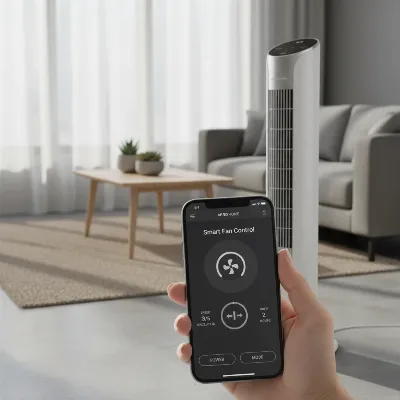 Smart home tower fan with smartphone control, modern living room background
Brand Reputation and Price
While the initial purchase price is a factor, considering brand reputation and long-term value is essential for energy-efficient appliances. Reputable brands like Dreo, Lasko, Levoit, Honeywell, and Dyson are known for their quality, performance, and durability. While models with advanced features, especially those with DC motors or smart connectivity, might have a higher upfront cost, the significant savings on electricity bills over their lifespan often justify the investment. It’s important to balance your budget with the desire for features that contribute to both comfort and efficiency.
Comparison of Top Energy-Efficient Tower Fans for Summer 2026
For Summer 2026, several tower fans stand out for their blend of energy efficiency, performance, and user-friendly features. Here’s a comparison of some of the best models:
| Model Name | Key Energy-Efficient Features | Noise Level (dB) | Oscillation Angle | Best For | Approx. Price Range |
|---|---|---|---|---|---|
| Dreo Nomad One Tower Fan | 4 modes (Normal, Natural, Sleep, Auto), Timer | 34 (lowest) | 90° | Sleeping, Quiet Operation | Moderate |
| Lasko Wind Curve Tower Fan | 3 speeds, Timer, Night setting | Moderate | 60° | Overall Value, General Cooling | Affordable |
| Dreo Pilot Max Tower Fan | 12 speeds, Timer (up to 12h), Auto Mode | Quiet (on low) | 30°-120° | Large Rooms, Customizable Airflow | Moderate-High |
| Levoit Classic 36-Inch Tower Fan | 5 speeds, Built-in temp sensor (auto-adjust), Sleep Mode | 28 (sleep mode) | 90° | Bedrooms, Smart Automation, Quiet | Moderate |
| Honeywell QuietSet 8-Speed Tower Fan | 8 speed options, Timer, Dimming | Very Quiet | Wide | Bedrooms, Ultra-Quiet Operation | Moderate |
| Dyson Pure Cool Gen1 TP10/TP07 | Bladeless, Air Purification, Smart home support, Energy-efficient motor | Quiet | Up to 350° | Premium, Air Quality, Design | High |
Each of these models offers a unique set of benefits, from the whisper-quiet operation of the Levoit Classic and Dreo Nomad One, perfect for light sleepers, to the powerful and wide-ranging airflow of the Dreo Pilot Max, suitable for larger spaces. The Dyson Pure Cool models provide a premium experience with added air purification.
Maximizing Efficiency: Tips for Using and Maintaining Your Tower Fan
To truly harness the energy-saving potential of your tower fan and ensure its longevity, proper usage and consistent maintenance are key.
Strategic Placement for Optimal Airflow: The placement of your tower fan can significantly impact its cooling effectiveness. Position it in a corner or against a wall where its oscillating motion can distribute air across the entire room. Placing it near an open window in the evening can draw in cooler night air, or near an air conditioning vent can help circulate conditioned air more widely, allowing you to raise your AC thermostat setting and save energy. Avoid placing it directly against furniture that might block its vents.
Combine with AC for Enhanced Circulation: Tower fans are excellent companions to air conditioning. By running your tower fan alongside your AC, you can more effectively circulate the cooled air throughout a room, making the space feel cooler and potentially allowing you to set your air conditioner to a higher, more energy-efficient temperature. This dual approach can lead to substantial reductions in your overall cooling costs.
Utilize Timers and Smart Modes: Always take advantage of your fan’s built-in timer. If you only need cooling for a few hours while you fall asleep, set the timer to automatically shut off. Similarly, if your fan has an “auto” or “eco” mode with a temperature sensor, activate it. This allows the fan to adjust its speed based on the room’s temperature, operating only as much as needed and preventing continuous, unnecessary power consumption.
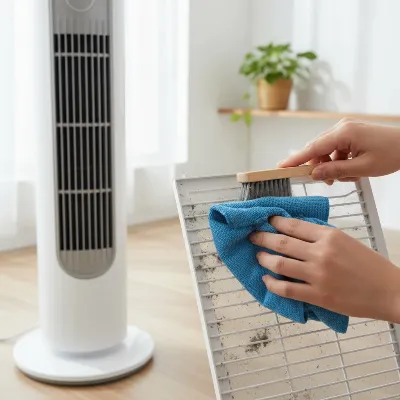 Person cleaning a tower fan, showing removable grille with dust, bright room
Regular Cleaning for Sustained Performance: Dust and debris can accumulate on the fan’s internal components and grilles, impeding airflow and forcing the motor to work harder, thus consuming more energy. Make it a habit to clean your tower fan regularly, at least once a month during peak usage. Many models feature removable grilles or filters that make cleaning easier. Use a soft brush, vacuum cleaner attachment, or a damp cloth to remove dust from the vents and internal blades. Always ensure the fan is unplugged before cleaning.
Proper Storage During Off-Season: When summer ends and your tower fan is no longer needed, proper storage will protect it and ensure it’s ready for the next season. Clean the fan thoroughly before storing it. Cover it with a cloth or its original packaging to prevent dust accumulation. Store it in a dry, safe place where it won’t be damaged, away from extreme temperatures or humidity.
“Investing in an energy-efficient tower fan with a DC motor and smart features is not just about staying cool; it’s about making a conscious choice to reduce your carbon footprint and save on household expenses over the long run.” – Dr. Emily R. Chen, Environmental Engineering Consultant
Conclusion
Choosing the best energy-efficient tower fan for Summer 2026 is a smart move for anyone seeking comfort without the burden of high utility bills. By understanding the advantages of DC motors, prioritizing features like multiple speed settings, timers, and smart controls, and selecting a model suited to your room size, you can enjoy a consistently cool and comfortable indoor environment. Regular maintenance, combined with strategic placement and use, further maximizes your fan’s efficiency and extends its lifespan. Embrace the power of intelligent cooling this summer, and make an informed choice for a refreshing, economical, and sustainable season. What features will you prioritize for your perfect summer breeze?
Frequently Asked Questions
How much electricity does a tower fan use compared to an AC?
Tower fans are significantly more energy-efficient, typically consuming 30-100 watts per hour, whereas air conditioners use 500-5000 watts. Running a tower fan costs only a few cents per day, making it a much more economical cooling solution than an AC unit.
Are bladeless tower fans more energy-efficient?
Bladeless tower fans, often featuring advanced motor technology like DC motors, can be very energy-efficient. While their initial cost is usually higher, they offer a smooth airflow, enhanced safety, and often include smart features that optimize energy usage.
What is a good decibel level for a quiet tower fan?
For a quiet environment, especially bedrooms or offices, a tower fan with a noise level between 30-50 decibels (dB) is considered good. Many models offer specific “sleep modes” that reduce the noise to below 35 dB, providing a peaceful cooling experience.
How often should I clean my tower fan?
It is recommended to clean your tower fan at least once a month during periods of regular use. Dust and debris accumulation can hinder airflow and reduce efficiency. Regular cleaning ensures optimal performance, air quality, and longevity of the fan.
Can a tower fan cool a whole room effectively?
A tower fan excels at circulating air throughout a room, making it feel cooler by creating a wind-chill effect. While it doesn’t lower the ambient temperature like an air conditioner, strategic placement and oscillation allow it to effectively distribute air, providing widespread comfort, especially when paired with an AC.
What does CFM mean for a tower fan?
CFM stands for Cubic Feet per Minute and is a measurement of the volume of air a fan can move. Matching the fan’s CFM to your room’s square footage is crucial for effective cooling. For instance, a medium-sized room (150-250 sq ft) typically requires a fan with 1500-3000 CFM.
