Keeping a large room comfortably cool can be a significant challenge, especially when traditional cooling methods fall short or prove inefficient. While central air conditioning is ideal, it’s not always an option, and running it constantly can lead to high energy bills. This is where the modern oscillating tower fan steps in, offering a sleek, powerful, and often energy-efficient solution to circulate air and enhance comfort in expansive living areas, open-plan offices, and spacious bedrooms.
Forget bulky box fans or cumbersome pedestal models that often dominate a room’s aesthetic. Today’s tower fans are designed to blend seamlessly into contemporary decor while delivering impressive airflow. But for large rooms, not just any tower fan will do. You need models engineered for superior air movement, wide oscillation, and intelligent features that truly make a difference. This guide will explore what makes a tower fan ideal for big spaces, the key factors to consider, and highlight the top oscillating tower fans poised to keep your large rooms breezy and comfortable throughout 2026.
What is a Tower Fan? Why Are They Popular for Large Spaces?
A tower fan is a tall, slender cooling device characterized by its vertical, space-saving design. Unlike conventional fans that use external spinning blades, tower fans feature internal impellers that draw air in from the back or sides and expel it through a long, narrow front vent. Their primary mechanism for widespread cooling in larger areas is oscillation, allowing the fan’s body to rotate back and forth, sweeping air across a broad horizontal plane.
Compared to their traditional counterparts like pedestal or box fans, tower fans offer distinct advantages that make them increasingly popular, even for larger rooms. Their slim profile means they can be tucked into corners or alongside furniture without occupying much floor space, making them ideal for areas where aesthetics and footprint are concerns. While historically pedestal fans might have offered more “brute force” airflow, advancements in tower fan technology have led to models capable of moving substantial volumes of air with wide oscillation angles, ensuring even distribution across large areas. Many modern tower fans also operate more quietly and come equipped with smart features, adding to their appeal for a sophisticated and comfortable home environment.
Types of Tower Fans Suitable for Large Rooms
Not all tower fans are created equal, especially when it comes to tackling the cooling demands of a large room. The best models for expansive spaces typically fall into a few key categories based on their design and technological prowess.
Firstly, High-CFM Tower Fans are paramount. CFM (Cubic Feet per Minute) measures the volume of air a fan can move. For a large room, you’ll need a fan capable of at least 800 CFM, with some experts recommending upwards of 1,500 to 3,000 CFM for truly spacious areas. These fans are engineered with more powerful motors and efficient air channels to deliver a strong, consistent breeze across greater distances, ensuring that air circulates effectively throughout the entire space.
Secondly, Wide-Angle Oscillating Tower Fans are crucial for comprehensive coverage. Standard tower fans might offer 60-degree oscillation, but for large rooms, look for models that sweep across 90, 120, 180, or even 350 degrees. This expansive rotation ensures that cool air reaches every corner of the room, preventing stagnant pockets and maintaining a consistent temperature.
Lastly, Smart and Feature-Rich Tower Fans enhance comfort and convenience. This category includes fans with advanced technology such as DC (Direct Current) motors for energy efficiency and quieter operation, bladeless designs for safety and sleek aesthetics, and integrated air purification systems for improved air quality. Smart features like Wi-Fi connectivity, app control, voice assistant compatibility, and auto modes that adjust fan speed based on ambient room temperature are becoming standard, offering effortless control and optimization for large living areas.
Factors to Consider When Buying an Oscillating Tower Fan for Large Rooms
Choosing the right oscillating tower fan for your large room involves more than just picking a stylish model. Several key factors must align with your specific needs to ensure effective cooling and lasting satisfaction.
Room Size and CFM
Table is empty.The most critical factor is ensuring the fan’s power matches your room’s dimensions. A fan that is too small for a large space will struggle to circulate air effectively, leaving areas feeling warm and stuffy. To determine your needs, calculate your room’s square footage (length x width). For large rooms, aiming for a fan with a high Cubic Feet per Minute (CFM) rating is essential. Experts suggest that for areas exceeding 250 square feet, a fan should deliver at least 800 CFM, with some powerful models reaching over 2,500 CFM for extra-large spaces or open-concept layouts. Also, consider ceiling height; rooms with higher ceilings require more powerful fans to move the increased volume of air efficiently. Room layout, including obstacles like large furniture, can also impact airflow, so consider a fan with strong, far-reaching air projection.
Oscillation Angle and Airflow Coverage
For a large room, widespread air distribution is key. An oscillating tower fan’s ability to pivot and sweep air across a broad area is vital. Look for models with a wide oscillation angle, typically 90 degrees or more. Some premium fans offer ultra-wide 120-degree, 180-degree, or even 350-degree oscillation, ensuring that cool air reaches every corner and occupant in an expansive space. This feature prevents focused blasts of air in one direction, instead providing a more ambient and comfortable cooling experience throughout the entire room.
Noise Level
While cooling power is important, excessive noise can detract from comfort, especially in a living room, office, or bedroom. Powerful fans, by nature, can sometimes be louder. However, many modern oscillating tower fans are engineered to operate quietly, even at higher settings. Look for fans that list their decibel (dB) range. For comfortable daytime use, a fan operating between 45-60 dB is acceptable, while for bedrooms or quiet environments, aim for models that register below 50 dB on their lower settings, with some “quiet set” models boasting levels as low as 25-30 dB.
Features and Smart Technology
Beyond basic cooling, modern tower fans offer an array of features that enhance usability and convenience. A remote control is almost indispensable for large rooms, allowing you to adjust settings from across the space. Multiple speed settings (e.g., 3 to 12+) and different modes (Normal, Natural Wind, Sleep, Turbo) provide customization for various comfort levels. Timers (1 to 12 hours) are excellent for energy saving and ensuring the fan turns off automatically. Advanced smart features like Wi-Fi connectivity, app control (e.g., via VeSync), and compatibility with voice assistants (Alexa, Google Assistant) offer seamless integration into a smart home ecosystem. Some fans also include auto modes that adjust fan speed based on room temperature, dimmable LED displays for nighttime use, and even air purification capabilities to capture allergens and dust.
Brand Reputation and Price
Investing in a well-regarded brand often translates to better performance, durability, and customer support. Leading brands in the tower fan market known for models suitable for large rooms include Dreo, Vornado, Levoit, Dyson, Lasko, and Honeywell. Prices can vary significantly based on power, features, and brand prestige. While budget-friendly options exist, more powerful fans with advanced smart features or air purification systems will command a higher price point. Consider your budget alongside the features most important for your large room to find the best value.
Top Oscillating Tower Fans for Large Rooms in 2026: A Comparison
Choosing the right fan for an expansive area means looking for models that stand out in terms of airflow, oscillation, and smart features. Here’s a comparison of some of the best oscillating tower fans well-suited for large rooms in 2026:
| Model | Key Features | Noise Level (Lowest Setting) | Best For | Pros | Cons |
|---|---|---|---|---|---|
| Dreo Pilot Max Tower Fan | 120° Oscillation, 12 Speeds, 4 Modes, 12H Timer, Remote | Quiet (not specified, but tested for sleep) | All-around large room cooling, customizable. | Exceptional cooling power, wide oscillation, extensive speed/mode options, user-friendly remote. | Can be pricier than basic models. |
| Vornado ARA Oscillating Tower Fan | 2,574 CFM, 180° Oscillation, 5 Speeds, Ambient Light | 29 dB | Extra-large, open-concept spaces. | Immense airflow (highest CFM), superior air circulation, wide oscillation, quiet on low settings. | Can be loud on highest settings, higher price point. |
| Levoit Classic 42-Inch Smart Tower Fan | 90° Oscillation, 12 Speeds, 4 Modes, Auto Mode, Wi-Fi/App Control | 25 dB | Smart homes, consistent comfort, quiet. | Powerful airflow (felt up to 25ft), auto-adjusting speeds, smart features, very quiet operation. | 90° oscillation is good, but some offer wider. |
| Dyson Pure Cool TP09 Purifying Fan | 350° Oscillation, 10 Speeds, Air Purification, Smart Home Support | Very Quiet | Premium cooling & air quality, allergies. | Bladeless design, advanced air purification, ultra-wide oscillation, sleek aesthetics, smart control. | Significantly higher price, might not offer the brute force of a Vornado. |
| Lasko Wind Curve T42951 Tower Fan | 60° Oscillation, 3 Speeds, Timer, Nighttime Setting, Remote | Moderate (not specified) | Value-focused large room cooling. | Affordable, decent cooling power, simple to use, convenient remote storage. | Limited oscillation range, fewer speed options compared to premium models. |
Recommendations:
- For those prioritizing maximum airflow and coverage in truly expansive, open spaces, the Vornado ARA Oscillating Tower Fan is an undeniable powerhouse.
- If you seek a blend of powerful cooling, smart features, and exceptionally quiet operation, the Levoit Classic 42-Inch Smart Tower Fan is an excellent choice.
- For a versatile fan that performs excellently across various large room scenarios with great customization, the Dreo Pilot Max Tower Fan consistently receives high praise.
- For the ultimate in premium features, air purification, and sophisticated design, the Dyson Pure Cool TP09 stands alone, albeit at a higher investment.
- If budget is a primary concern but you still need effective cooling for a large room, the Lasko Wind Curve T42951 Tower Fan offers solid value.
Tips for Using and Maintaining Your Tower Fan for Optimal Performance
To get the most out of your oscillating tower fan, especially in a large room, proper usage and regular maintenance are key. These practices not only enhance cooling efficiency but also prolong the lifespan of your appliance.
Strategic Placement for Optimal Airflow
The placement of your tower fan can significantly impact its effectiveness in a large room. Position the fan in a corner or against a wall to allow its oscillation feature to sweep air across the widest possible area. Ensure there are no large obstructions immediately in front of or behind the fan that could block airflow. For exceptionally large or oddly shaped rooms, consider placing the fan near a doorway or window to draw in cooler air or push out warmer air, creating a more effective air current. In a living room, placing it where it can create a cross-breeze with an open window or another fan can further enhance comfort.
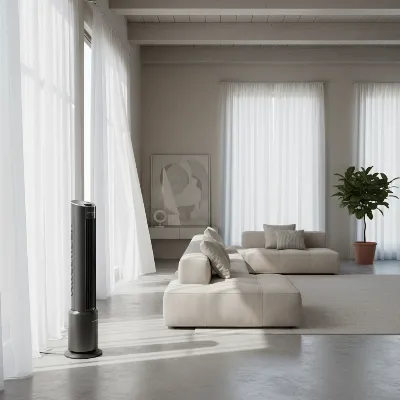 An oscillating tower fan strategically placed in a large, modern living room corner, sweeping air across the space.
Regular Cleaning for Health and Efficiency
Over time, dust and debris can accumulate on the fan’s grilles and internal components, reducing airflow and potentially affecting air quality. Most tower fans for large rooms feature removable grilles or filter screens that make cleaning easier. For models with accessible parts, use a soft cloth, a vacuum cleaner with a brush attachment, or compressed air to remove dust from the grilles, vents, and internal blades. Always unplug the fan before cleaning. Regular cleaning—ideally once a month during peak usage—ensures your fan operates at peak efficiency, circulates clean air, and prevents strain on the motor.
Maximizing Energy Efficiency
Tower fans are generally more energy-efficient than air conditioners, but smart usage can further reduce your electricity consumption. Utilize the fan’s built-in timer function to set it to turn off after you’ve fallen asleep or left the room. Employing “Natural” or “Eco” modes, if available, can save energy by varying fan speeds to mimic a natural breeze rather than running at a constant high setting. Many smart tower fans also feature “Auto” modes that adjust fan speed based on ambient room temperature, optimizing cooling without constant manual intervention. Using your tower fan in conjunction with an air conditioner, by circulating cooled air, can allow you to set your AC thermostat a few degrees higher, leading to additional energy savings.
 A person cleaning the grille of a modern tower fan with a soft brush, emphasizing easy maintenance.
Proper Storage During Off-Season
When the weather cools down and your tower fan is no longer needed, proper storage is essential to protect it from dust and damage. Clean the fan thoroughly before storing. If it comes with its original packaging, use it for storage; otherwise, cover the fan with a plastic bag or a dust cover to prevent dust accumulation. Store it in a dry, cool place away from direct sunlight or extreme temperatures. This simple step ensures your fan remains in excellent condition and is ready for efficient use when the warm weather returns.
Conclusion
Navigating the warmth of larger living spaces no longer requires compromising on style or functionality. The best oscillating tower fans for large rooms in 2026 stand as sophisticated, powerful solutions, seamlessly blending into your home while delivering a refreshing breeze across expansive areas. By prioritizing factors like high CFM, wide oscillation angles, and intelligent features, you can ensure your chosen fan effectively addresses the unique cooling demands of larger environments.
Modern tower fans, from the robust airflow of a Vornado to the smart, quiet operation of a Levoit, or the purifying power of a Dyson, offer tailored comfort. Coupled with strategic placement and routine maintenance, these appliances are more than just fans; they are essential components for creating an optimally comfortable and energy-efficient home. Are you ready to transform your large room into a cool oasis?
Câu Hỏi Thường Gặp
How big of a room can a tower fan cool?
Modern tower fans designed for large rooms can effectively circulate air in spaces ranging from 250 to over 800 square feet, depending on their CFM rating and oscillation capabilities. For very large or open-concept areas, look for fans with higher CFM (e.g., 1000+ CFM) and wider oscillation (120-180 degrees or more).
Are oscillating tower fans noisy?
The noise level of oscillating tower fans varies significantly by model and speed setting. While powerful fans can be louder on their highest settings, many modern units are designed for quiet operation, especially on lower speeds. “Quiet set” models can operate as low as 25-30 decibels, making them suitable for bedrooms and quiet living areas.
What is a good CFM for a large room tower fan?
For a large room, a good CFM (Cubic Feet per Minute) for a tower fan is generally at least 800 CFM. For truly expansive spaces or open layouts (over 250-300 sq ft), aiming for 1500-2500 CFM or higher will provide more effective and widespread air circulation.
Do tower fans actually cool a room or just circulate air?
Fans, including tower fans, primarily circulate existing air, creating a wind-chill effect that makes you feel cooler by accelerating evaporation from your skin. They do not actively lower the ambient temperature of a room like an air conditioner. However, by effectively circulating air, they can enhance comfort and make your existing AC more efficient.
How often should I clean my tower fan?
It is recommended to clean your Tower Fan at least once a month during periods of regular use. If you live in a dusty environment or have pets, more frequent cleaning may be necessary. Regular cleaning of grilles and vents prevents dust buildup, maintains optimal airflow, and improves air quality.