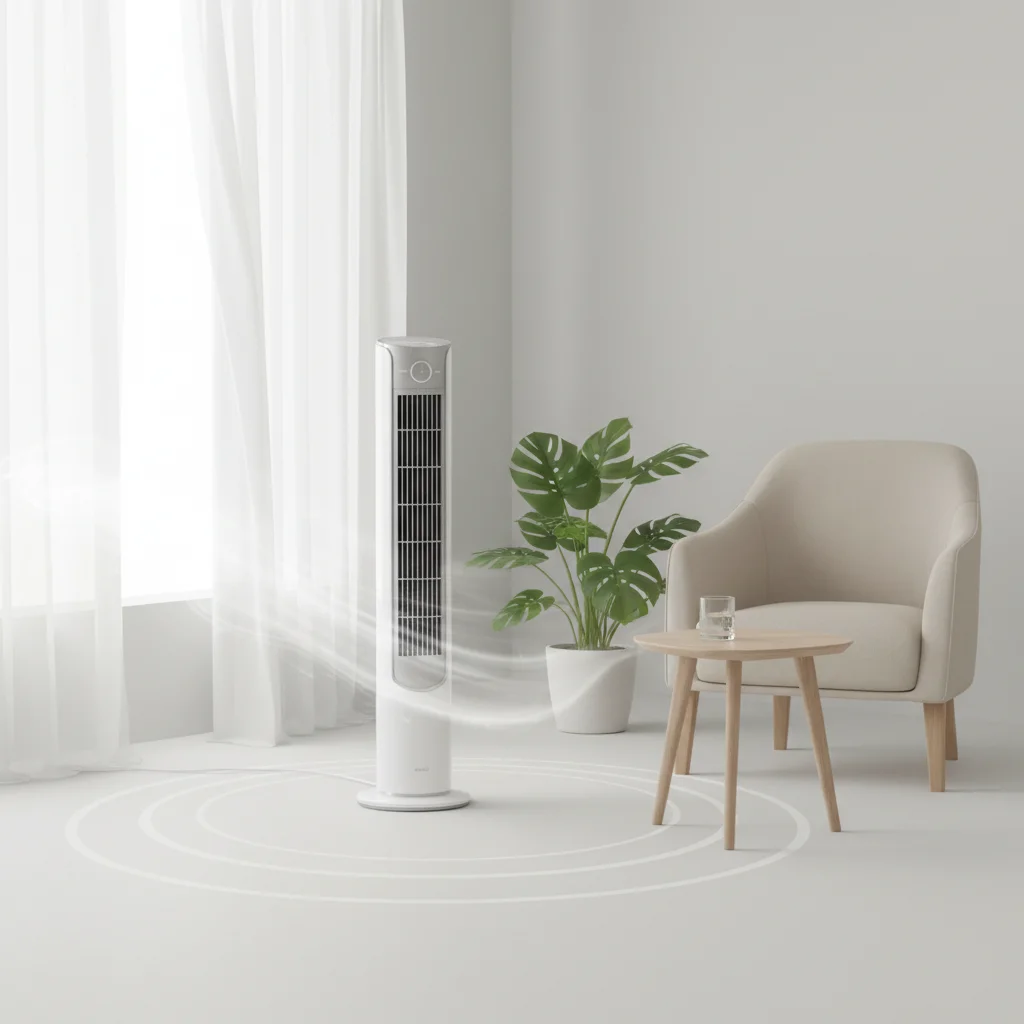
Optimal tower fan placement is crucial for maximizing its cooling efficiency and ensuring comfortable airflow throughout your space. The best location for a tower fan is typically in a corner or against a wall, angled towards the center of the room or directly at the area you want to cool. This strategic positioning allows the fan’s oscillation to distribute air effectively, creating a more consistent and widespread cooling effect. Avoid placing it in cluttered areas or directly behind large furniture that could obstruct airflow.
Understanding Airflow Dynamics for Tower Fans
To truly optimize your tower fan’s performance, it’s important to understand how air moves within a room. Tower fans are designed to create a column of air that can be directed. When placed strategically, they can either push cool air from one area to another or help circulate existing air to reduce stuffiness. Consider the natural air currents in your room, especially if you have windows or other ventilation sources. Positioning your fan to work with these currents, rather than against them, will yield better results. For browse all reviews articles on this site.
For instance, if you have a window open on a cooler evening, placing your tower fan near it, facing inwards, can help draw that cooler air into the room more efficiently. Conversely, during hotter periods, placing the fan to exhaust warm air out of an open window can also be effective. The key is to create a continuous flow, preventing air from becoming stagnant.
Best Locations for Different Room Types
The ideal placement can vary significantly depending on the room’s purpose and layout. In a bedroom, for example, placing the fan at the foot of the bed, slightly off-center, can provide a gentle breeze across the entire sleeping area without being too direct or noisy. For living rooms, a corner near a seating area often works well, allowing the oscillating fan to cover a wider zone. In home offices, direct placement on a desk or nearby floor can offer personalized cooling without disturbing papers.
- Bedrooms: Foot of the bed, slightly off-center, or near an open window.
- Living Rooms: Corner of the room, angled towards the main seating area.
- Home Offices: On a desk or floor, directed at the user.
- Kitchens: Away from cooking heat, aimed to circulate air towards exits.
- Small Spaces: Against a wall, maximizing the oscillating range.
Avoiding Common Placement Mistakes
|
Our Picks for the Best Tower Fan in 2026
As an Amazon Associate I earn from qualifying purchases.
|
||
| Num | Product | Action |
|---|---|---|
| 1 | Dreo Tower Fan for Bedroom, 25ft/s Velocity Quiet Floor Fan, 90° Oscillating Fans for Indoors with 4 Speeds, 4 Modes, 8H Timer, Bladeless Fan, Standing Fans, Silver, Nomad One (DR-HTF007) |

|
| 2 | DREO Tower Fan for Bedroom, 4 Speeds, 3 Modes Standing Fans for Room with 90° wide Oscillating, 28dB Quiet for Sleep, 25ft/s Velocity, 29ft Coverage, 8H Timer, Remote, Living Room, Office, Home, White |
|
| 3 | Lasko Elevation Adjustable Tower Fan 42”-54”, Pedestal Fan, 31 ft/s Airflow, Quiet 28 dB, 90° Oscillation, 12h Timer, Remote, Black, EST100 |
|
| 4 | Dreo Tower Fan for Bedroom, 90° Oscillating Standing Fans for Room with 4 Speeds, 3 Modes, 28dB Quiet for Sleep, 25ft/s Velocity, 8H Timer, Remote, Living Room, Office, Home, Black |
|
| 5 | Honeywell QuietSet Whole Room Tower Fan-Black, Oscillating Tower Fan with Remote, HYF290B |
|
| 6 | PELONIS 40-Inch Tower Fan for Bedroom, Fan That Blows Cold Air, Oscillating Fan with Innovative Washable Design, 2000 CFM, 28ft/s Airflow, 4 Speeds + 2 Modes, 90° Oscillation, 23dB Quiet |
|
| 7 | Dreo Tower Fan for Bedroom, 2026 Upgraded DC Motor, 28ft/s High Velocity, 20dB Ultra Quiet Standing Fan, 8 Speeds 4 Modes, 90° Oscillating Bladeless Fan for Indoors, Floor Fans with Remote, Black |
|
| 8 | Honeywell QuietSet Whole Room Oscillating Tower filter Fan with Remote, White, HYF260 |
|
| 9 | Lasko High Velocity Oscillating Tower Fan for Bedroom, Garage, Basement, and Gym with Remote Control, Timer, 3 Powerful Speeds, 35" Silver/Black, U35115 |
|
| 10 | LEVOIT Tower Fan for Bedroom, 25ft/s Velocity Standing Fan with 28dB Quiet for Sleep, Remoter, 12H Timer, 5 Speeds, 4 Modes, 90° Oscillation for Home, Office, Indoor, Bladeless 36 inch, White |
|
Many users inadvertently reduce their tower fan’s effectiveness through poor placement. A common error is placing the fan too close to a wall, which can restrict airflow and reduce its oscillation range. Another mistake is positioning it in a highly trafficked area where it can be easily knocked over or its airflow constantly interrupted. Avoid placing it directly in front of heat sources like radiators or direct sunlight, as this will only circulate warm air.
Furthermore, ensure the fan’s intake vents (usually at the back or sides) are not blocked by curtains, furniture, or other objects. Clear intake allows the fan to draw in air more efficiently, leading to better cooling performance. Regularly check for dust buildup around these vents, as this can also impede airflow.
Integrating Tower Fans with Other Cooling Methods
Tower fans can work synergistically with other cooling systems to enhance overall comfort. If you have an air conditioner, placing a tower fan in a room that struggles to cool can help distribute the conditioned air more evenly, reducing hot spots and potentially allowing you to set your AC thermostat a degree or two higher, saving energy.Similarly, when used with open windows, a tower fan can create a cross-breeze effect, drawing in fresh air and expelling stale, warm air. This combination is particularly effective during mild weather when full air conditioning isn’t necessary.
Consider using multiple fans in larger spaces, strategically placed to create a continuous flow path. For example, one fan can draw air in from a cooler part of the house, while another pushes it towards a warmer area. This method is often more energy-efficient than relying solely on a single, powerful fan to cover a vast area.
Maintenance and Environmental Factors
Beyond initial placement, ongoing maintenance and awareness of environmental factors play a role in your tower fan’s long-term effectiveness. Regularly cleaning the fan’s grilles and filters prevents dust buildup, which can restrict airflow and reduce efficiency. The ambient humidity and temperature of your environment also influence how effective your fan feels. In very humid conditions, a fan might feel less effective at cooling the air itself, but it will still help with evaporation from your skin, providing a perceived cooling effect.
Finally, consider the height of your fan relative to where you spend most of your time. If you’re typically sitting, a fan placed on the floor might be perfect. If you’re standing or moving around, a taller fan or one placed on a low table might be more appropriate to ensure the airflow reaches you comfortably.
