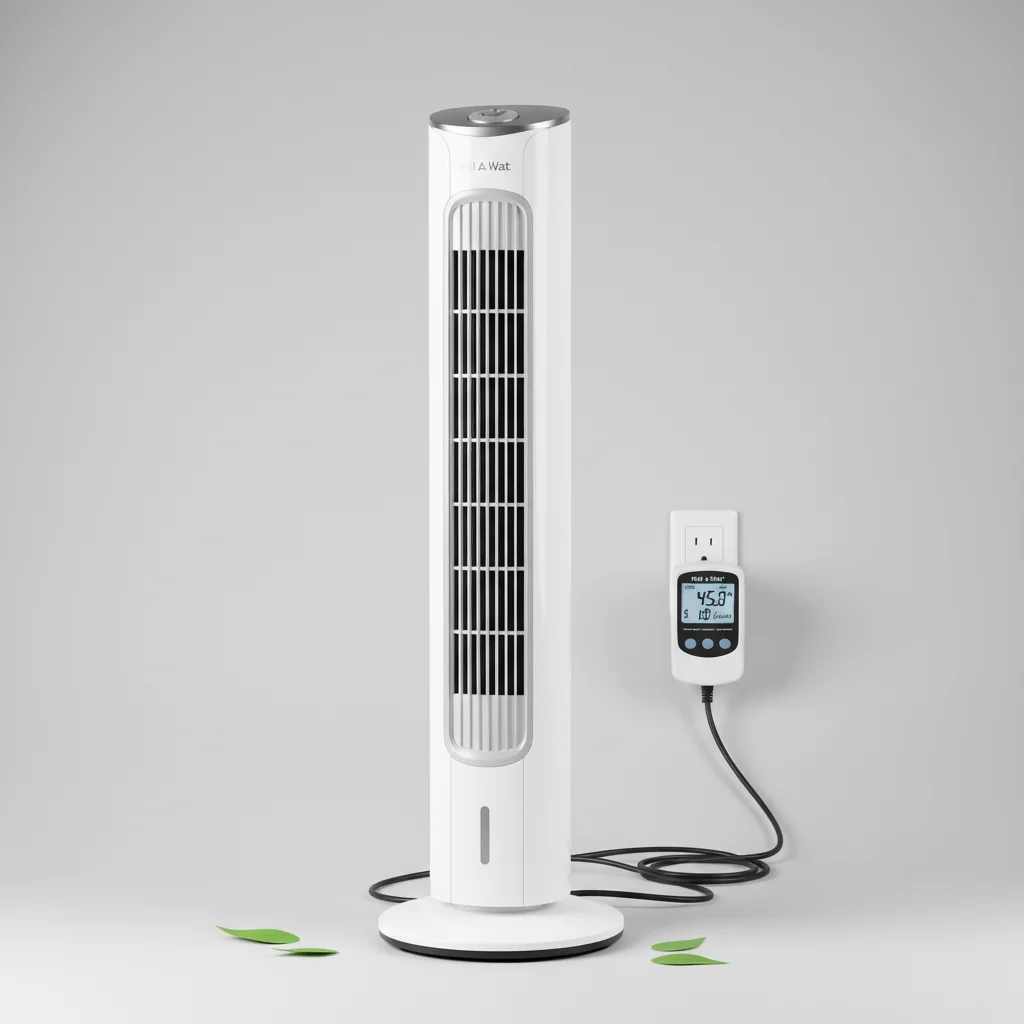
Understanding tower fan power consumption is crucial for managing your electricity bills, especially during warmer months. On average, a typical tower fan uses between 30 to 100 watts of power, which translates to a cost of roughly $0.003 to $0.01 per hour, or about $2.16 to $7.20 per month if run continuously. This makes tower fans a highly energy-efficient cooling option compared to air conditioners.
Factors Influencing Tower Fan Power Consumption
Several factors dictate how much power your tower fan consumes. The fan’s motor size, speed settings, and special features like oscillation, timers, or smart connectivity all play a role. A fan running on its highest setting will naturally draw more power than one on a low setting. Additionally, older models might be less efficient than newer, energy-star-rated fans due to advancements in motor technology.
Calculating Your Tower Fan’s Energy Cost
To calculate the exact cost of running your tower fan, you’ll need its wattage and your local electricity rate. Most tower fans have their wattage listed on a label or in the user manual. Multiply the wattage by the number of hours you use the fan, then by your electricity rate (in dollars per kilowatt-hour). For example, a 50-watt fan used 8 hours a day at $0.15/kWh would cost (50W * 8h * 30 days / 1000) * $0.15 = $1.80 per month. This simple calculation helps you budget for your cooling needs.
Energy-Saving Tips for Tower Fan Users
|
Our Picks for the Best Tower Fan in 2026
As an Amazon Associate I earn from qualifying purchases.
|
||
| Num | Product | Action |
|---|---|---|
| 1 | Dreo Tower Fan for Bedroom, 2026 Upgraded DC Motor, 28ft/s High Velocity, 20dB Ultra Quiet Standing Fan, 8 Speeds 4 Modes, 90° Oscillating Bladeless Fan for Indoors, Floor Fans with Remote, Black |

|
| 2 | Honeywell QuietSet Whole Room Tower Fan-Black, Oscillating Tower Fan with Remote, HYF290B |
|
| 3 | Dreo Tower Fan for Bedroom, 25ft/s Velocity Quiet Floor Fan, 90° Oscillating Fans for Indoors with 4 Speeds, 4 Modes, 8H Timer, Bladeless Fan, Standing Fans, Silver, Nomad One (DR-HTF007) |
|
| 4 | Lasko Elevation Adjustable Tower Fan 42”-54”, Pedestal Fan, 31 ft/s Airflow, Quiet 28 dB, 90° Oscillation, 12h Timer, Remote, Black, EST100 |
|
| 5 | Honeywell QuietSet Whole Room Oscillating Tower filter Fan with Remote, White, HYF260 |
|
| 6 | LEVOIT Tower Fan for Bedroom, 25ft/s Velocity Standing Fan with 28dB Quiet for Sleep, Remoter, 12H Timer, 5 Speeds, 4 Modes, 90° Oscillation for Home, Office, Indoor, Bladeless 36 inch, White |
|
| 7 | DREO Tower Fan for Bedroom, 4 Speeds, 3 Modes Standing Fans for Room with 90° wide Oscillating, 28dB Quiet for Sleep, 25ft/s Velocity, 29ft Coverage, 8H Timer, Remote, Living Room, Office, Home, White |
|
| 8 | Dreo Tower Fan for Bedroom, 90° Oscillating Standing Fans for Room with 4 Speeds, 3 Modes, 28dB Quiet for Sleep, 25ft/s Velocity, 8H Timer, Remote, Living Room, Office, Home, Black |
|
| 9 | PELONIS 40-Inch Tower Fan for Bedroom, Fan That Blows Cold Air, Oscillating Fan with Innovative Washable Design, 2000 CFM, 28ft/s Airflow, 4 Speeds + 2 Modes, 90° Oscillation, 23dB Quiet |
|
| 10 | Lasko High Velocity Oscillating Tower Fan for Bedroom, Garage, Basement, and Gym with Remote Control, Timer, 3 Powerful Speeds, 35" Silver/Black, U35115 |
|
Maximizing the efficiency of your tower fan can lead to significant savings. Here are some practical tips:
- Use the lowest effective speed setting.
- Utilize timer functions to turn off the fan when not needed.
- Position the fan strategically to enhance air circulation.
- Keep the fan clean to ensure optimal performance.
- Consider upgrading to an energy-efficient model.
These small adjustments can collectively reduce your energy consumption without sacrificing comfort.
Comparing Tower Fan Efficiency to Other Cooling Appliances
When stacked against other cooling solutions, tower fans are remarkably energy-efficient. A central air conditioner can consume thousands of watts, while even a window AC unit typically uses hundreds. A tower fan, with its modest power draw, offers a cost-effective way to cool individual rooms or personal spaces. While it won’t cool an entire house like an AC, its targeted cooling makes it an excellent supplementary or primary option for localized comfort.
The Impact of Features on Power Use
Modern tower fans come with a variety of features that can subtly affect power consumption. Oscillation, for instance, adds a small amount of power draw, usually less than 5 watts, but greatly improves air distribution. Smart features like Wi-Fi connectivity or remote control also require minimal power. While these features enhance convenience, their impact on overall power consumption is generally negligible compared to the main motor’s operation. Always check the product specifications if energy efficiency is a top priority.
Maintaining Your Tower Fan for Optimal Efficiency
Regular maintenance is key to ensuring your tower fan operates at peak efficiency and doesn’t consume more power than necessary. Dust and debris can accumulate on the fan blades and internal components, forcing the motor to work harder. Cleaning the air intake and exhaust vents, as well as the fan blades (if accessible), can prevent this. A well-maintained fan runs smoother, quieter, and more efficiently, extending its lifespan and keeping your energy costs down.
