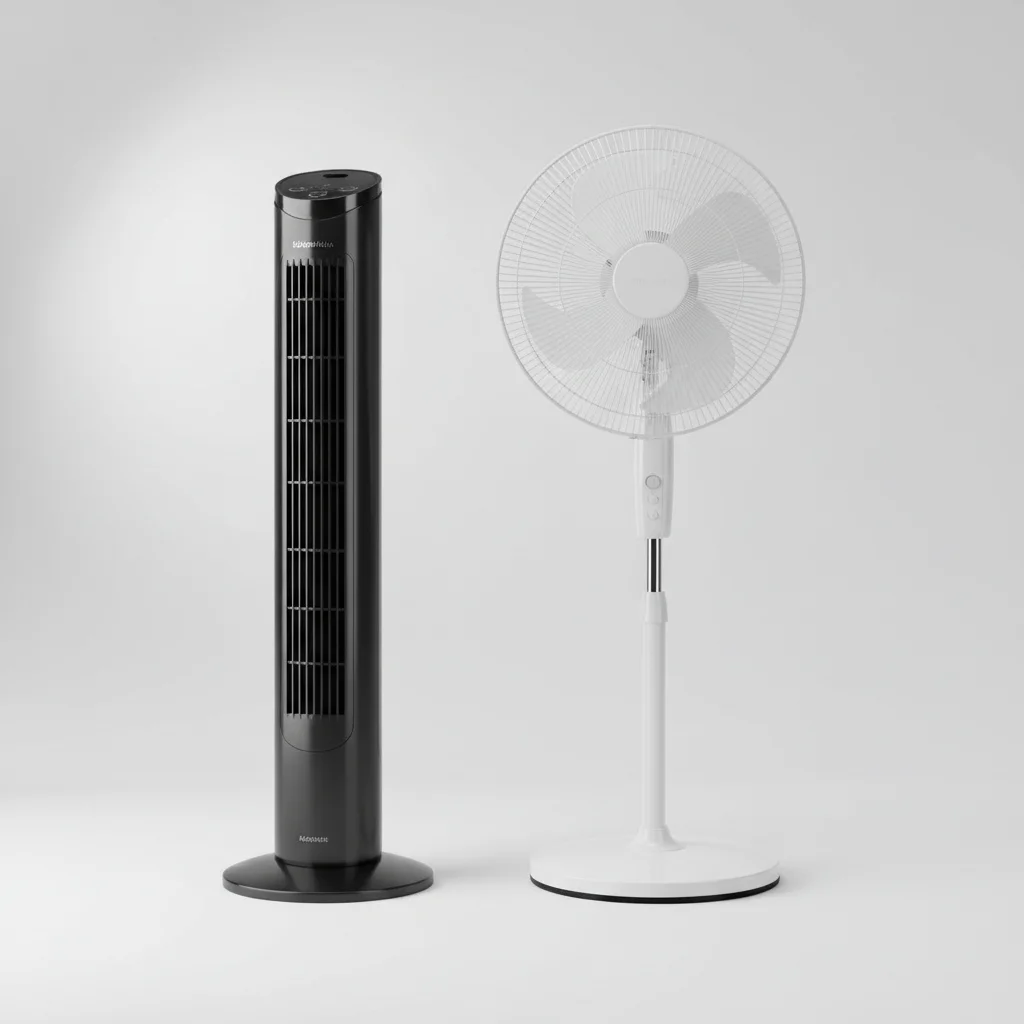
Choosing between a tower fan and a pedestal fan can significantly impact your home’s comfort and aesthetic. While both aim to cool your space, they differ in design, airflow, and features. Generally, a tower fan is better for modern aesthetics and space-saving, offering a wider oscillation and often quieter operation, making it ideal for bedrooms and living areas. A pedestal fan, on the other hand, provides more direct, powerful airflow and adjustable height, making it suitable for workshops or larger, open spaces where strong air circulation is paramount.
Design and Aesthetics: A Modern vs. Classic Look
Tower fans boast a sleek, vertical design that blends seamlessly into contemporary decor. Their slim profile occupies minimal floor space, making them an excellent choice for smaller rooms or areas where aesthetics are a priority. Pedestal fans, with their traditional three-pronged base and visible blades, offer a more classic, utilitarian look. While they might not be as discreet, their design often allows for greater adjustability in height and tilt, directing airflow precisely where needed. For see our reviews recommendations on this site.
Airflow and Coverage: Wide Sweep vs. Direct Blast
One of the primary distinctions lies in how each fan distributes air. Tower fans typically feature a wide oscillation range, often up to 90 degrees or more, providing a broad sweep of air that can cool an entire room more evenly. This makes them effective for general ambient cooling. Pedestal fans, with their larger, exposed blades, are designed to deliver a more powerful, direct blast of air. This focused airflow is highly effective for personal cooling or for quickly circulating air in a specific zone.
Noise Levels and Features: Quiet Comfort vs. Powerful Performance
|
Our Picks for the Best Tower Fan in 2026
As an Amazon Associate I earn from qualifying purchases.
|
||
| Num | Product | Action |
|---|---|---|
| 1 | Lasko Elevation Adjustable Tower Fan 42”-54”, Pedestal Fan, 31 ft/s Airflow, Quiet 28 dB, 90° Oscillation, 12h Timer, Remote, Black, EST100 |

|
| 2 | Dreo Tower Fan for Bedroom, 2026 Upgraded DC Motor, 28ft/s High Velocity, 20dB Ultra Quiet Standing Fan, 8 Speeds 4 Modes, 90° Oscillating Bladeless Fan for Indoors, Floor Fans with Remote, Black |
|
| 3 | PELONIS 40-Inch Tower Fan for Bedroom, Fan That Blows Cold Air, Oscillating Fan with Innovative Washable Design, 2000 CFM, 28ft/s Airflow, 4 Speeds + 2 Modes, 90° Oscillation, 23dB Quiet |
|
| 4 | LEVOIT Tower Fan for Bedroom, 25ft/s Velocity Standing Fan with 28dB Quiet for Sleep, Remoter, 12H Timer, 5 Speeds, 4 Modes, 90° Oscillation for Home, Office, Indoor, Bladeless 36 inch, White |
|
| 5 | Honeywell QuietSet Whole Room Oscillating Tower filter Fan with Remote, White, HYF260 |
|
| 6 | DREO Tower Fan for Bedroom, 4 Speeds, 3 Modes Standing Fans for Room with 90° wide Oscillating, 28dB Quiet for Sleep, 25ft/s Velocity, 29ft Coverage, 8H Timer, Remote, Living Room, Office, Home, White |
|
| 7 | Honeywell QuietSet Whole Room Tower Fan-Black, Oscillating Tower Fan with Remote, HYF290B |
|
| 8 | Dreo Tower Fan for Bedroom, 90° Oscillating Standing Fans for Room with 4 Speeds, 3 Modes, 28dB Quiet for Sleep, 25ft/s Velocity, 8H Timer, Remote, Living Room, Office, Home, Black |
|
| 9 | Dreo Tower Fan for Bedroom, 25ft/s Velocity Quiet Floor Fan, 90° Oscillating Fans for Indoors with 4 Speeds, 4 Modes, 8H Timer, Bladeless Fan, Standing Fans, Silver, Nomad One (DR-HTF007) |
|
| 10 | Lasko High Velocity Oscillating Tower Fan for Bedroom, Garage, Basement, and Gym with Remote Control, Timer, 3 Powerful Speeds, 35" Silver/Black, U35115 |
|
Many modern tower fans are engineered for quiet operation, making them ideal for bedrooms, nurseries, or home offices where noise can be a distraction. They often come with advanced features such as multiple speed settings, sleep modes, remote controls, and even air purification capabilities. Pedestal fans, while generally louder due to their larger motors and exposed blades, excel in raw power. They are often simpler in design, focusing on robust air movement rather than advanced features, though some models do include oscillation and multiple speeds.
- Tower fans offer a space-saving, modern design.
- Pedestal fans provide powerful, direct airflow.
- Tower fans are generally quieter with wider oscillation.
- Pedestal fans are more adjustable in height and tilt.
- Consider room size and desired airflow type for optimal choice.
Portability and Placement: Easy Relocation vs. Stable Positioning
Both fan types offer a degree of portability, but their design influences how easily they can be moved and positioned. Tower fans are generally lighter and easier to carry from room to room, and their compact footprint allows for flexible placement in tight spaces. Pedestal fans, while often heavier, offer the advantage of adjustable height, allowing you to direct airflow over furniture or across a larger area. Their stable base also makes them less prone to tipping, which can be a consideration in busy households.
Ultimately, the best choice depends on your specific needs. If you prioritize sleek design, quiet operation, and wide room coverage, a tower fan is likely your best bet.However, if powerful, direct airflow and adjustable height are more important, a pedestal fan will serve you better.Consider the size of your room, your aesthetic preferences, and the primary purpose of the fan before making your decision.
