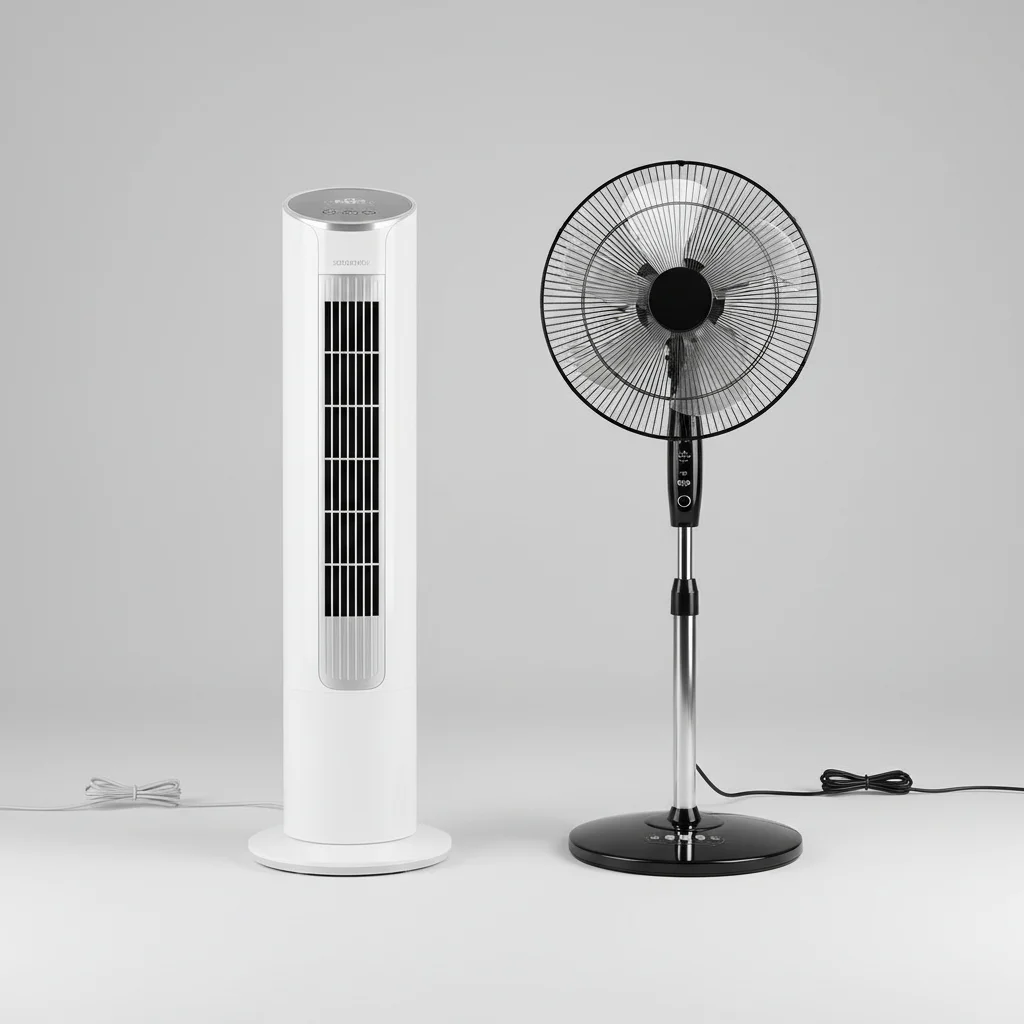
When deciding between a tower fan and a standing fan, the better choice for your home largely depends on your specific needs regarding space, airflow, and aesthetic preferences. Tower fans are generally more space-efficient and offer a wider oscillation range, making them ideal for smaller rooms or areas where floor space is at a premium. Standing fans, on the other hand, often provide a more powerful, direct airflow and can be adjusted in height, which is beneficial for larger rooms or when you need to direct air to a specific spot.
Space Efficiency and Design
Tower fans are renowned for their slim, vertical design, which allows them to fit into tight corners and blend seamlessly with modern decor. Their compact footprint makes them an excellent option for apartments, bedrooms, or offices where floor space is limited. Standing fans, while also available in various designs, typically have a larger base and a more prominent profile due to their adjustable height and wider fan head. This can be a consideration if you have a minimalist aesthetic or are working with restricted space.
Airflow and Coverage
The airflow characteristics differ significantly between the two types. Tower fans utilize an internal vertical impeller to draw air in and expel it over a wider vertical area, often with a broad oscillation angle. This creates a more diffused, whole-room cooling effect, which is great for general air circulation. Standing fans, with their traditional blade design, tend to produce a more concentrated and powerful blast of air. They excel at direct cooling and can be particularly effective in larger rooms or outdoor spaces where you need to feel the breeze from a distance. The ability to adjust the height of a standing fan also allows for more precise targeting of airflow.
Noise Levels and Features
|
Our Picks for the Best Tower Fan in 2026
As an Amazon Associate I earn from qualifying purchases.
|
||
| Num | Product | Action |
|---|---|---|
| 1 | Dreo Tower Fan for Bedroom, 2026 Upgraded DC Motor, 28ft/s High Velocity, 20dB Ultra Quiet Standing Fan, 8 Speeds 4 Modes, 90° Oscillating Bladeless Fan for Indoors, Floor Fans with Remote, Black |

|
| 2 | Dreo Tower Fan for Bedroom, 25ft/s Velocity Quiet Floor Fan, 90° Oscillating Fans for Indoors with 4 Speeds, 4 Modes, 8H Timer, Bladeless Fan, Standing Fans, Silver, Nomad One (DR-HTF007) |
|
| 3 | PELONIS 40-Inch Tower Fan for Bedroom, Fan That Blows Cold Air, Oscillating Fan with Innovative Washable Design, 2000 CFM, 28ft/s Airflow, 4 Speeds + 2 Modes, 90° Oscillation, 23dB Quiet |
|
| 4 | Lasko High Velocity Oscillating Tower Fan for Bedroom, Garage, Basement, and Gym with Remote Control, Timer, 3 Powerful Speeds, 35" Silver/Black, U35115 |
|
| 5 | LEVOIT Tower Fan for Bedroom, 25ft/s Velocity Standing Fan with 28dB Quiet for Sleep, Remoter, 12H Timer, 5 Speeds, 4 Modes, 90° Oscillation for Home, Office, Indoor, Bladeless 36 inch, White |
|
| 6 | Dreo Tower Fan for Bedroom, 90° Oscillating Standing Fans for Room with 4 Speeds, 3 Modes, 28dB Quiet for Sleep, 25ft/s Velocity, 8H Timer, Remote, Living Room, Office, Home, Black |
|
| 7 | Honeywell QuietSet Whole Room Oscillating Tower filter Fan with Remote, White, HYF260 |
|
| 8 | DREO Tower Fan for Bedroom, 4 Speeds, 3 Modes Standing Fans for Room with 90° wide Oscillating, 28dB Quiet for Sleep, 25ft/s Velocity, 29ft Coverage, 8H Timer, Remote, Living Room, Office, Home, White |
|
| 9 | Lasko Elevation Adjustable Tower Fan 42”-54”, Pedestal Fan, 31 ft/s Airflow, Quiet 28 dB, 90° Oscillation, 12h Timer, Remote, Black, EST100 |
|
| 10 | Honeywell QuietSet Whole Room Tower Fan-Black, Oscillating Tower Fan with Remote, HYF290B |
|
Modern tower fans are often designed with quiet operation in mind, making them suitable for bedrooms or quiet workspaces. Many models come with multiple speed settings, sleep modes, and even remote controls for convenience. Standing fans can vary more in noise level depending on their motor and blade design, with some high-velocity models being quite loud. However, many standing fans also offer features like oscillation, multiple speeds, and remote controls. When considering features, think about what is most important for your daily use.
- Space-saving design for small rooms.
- Wider oscillation for whole-room cooling.
- Often quieter operation for bedrooms.
- Modern aesthetic appeal.
- Remote control and smart features.
Maintenance and Cleaning
Cleaning a tower fan can be a bit more involved due to its enclosed design. Dust and debris can accumulate on the internal impeller, requiring careful disassembly or the use of specialized tools for thorough cleaning. Standing fans, with their more open design, are generally easier to clean. The fan blades and grille can often be removed or accessed more readily, allowing for quick wiping or dusting. Regular cleaning is crucial for both types of fans to maintain optimal performance and air quality.
Ultimately, the choice between a tower fan and a standing fan boils down to your personal priorities. If space-saving design, quiet operation, and whole-room air circulation are paramount, a tower fan is likely your best bet. If you prioritize powerful, direct airflow, height adjustability, and easier cleaning, a standing fan might be more suitable. Consider the size of the room, your aesthetic preferences, and the specific cooling needs you have before making your final decision.For those seeking a balance of features, exploring models with advanced settings and energy efficiency can also be a wise approach.
